
Navy SEAL Breathing Technique for Sleep: The Military Secret to Falling Asleep in 2 Minutes
Navy SEALs can fall asleep in minutes, even in a war zone.
They use a controlled breathing method that shuts down the stress response and triggers deep sleep on demand. This military sleep technique isn’t reserved for elite operators. Anyone struggling with sleep onset can try using it tonight.
There is one catch, though. A hidden factor could undermine the whole thing. Here’s what makes it work, why it sometimes fails, and what to do to drift off like a SEAL tonight.
The Combat-Tested Science of Sleep
In the field, switching from high-alert to deep sleep isn’t a luxury for a Navy SEAL. It’s a survival skill.
What they’ve developed is precise control over the parasympathetic nervous system, the part of the autonomic nervous system responsible for rest, digestion, and recovery. Activating it on command does several things at once:
- Drops heart rate to levels that support sleep onset
- Lowers cortisol and adrenaline in the bloodstream
- Shifts the body out of fight-or-flight mode
- Quiets the kind of mental hyperarousal that keeps people awake
This is the same physiological pathway targeted by light-based sleep aids.
The Dodow, for example, uses slow light pulses projected onto the ceiling to pace your breathing and guide your nervous system into a sleep-ready state.
If you want a device that does the pacing for you, read our full Dodow review here. But the SEAL method gives you direct control without needing anything at all.
The Traditional Navy SEAL 4-7-8 Breathing Method
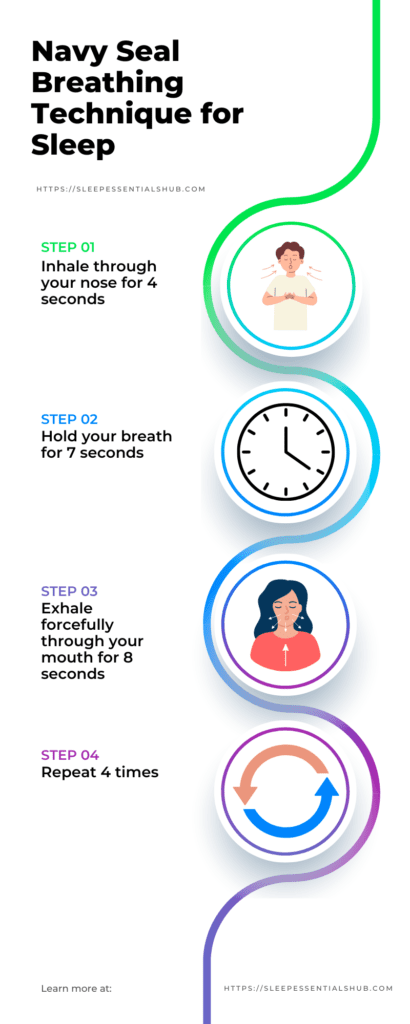
The foundational technique used by military personnel for sleep and stress recovery follows a simple pattern:
- Inhale slowly through the nose for 4 seconds.
- Hold your breath for 7 seconds.
- Exhale forcefully through your mouth for 8 seconds.
- Repeat 4 times.
The extended exhale is what does the heavy lifting. Slow, prolonged exhalation stimulates the vagus nerve and increases heart rate variability, both of which are reliable markers of parasympathetic activation.
The hold phase builds carbon dioxide tolerance, which has a calming effect on the central nervous system.
The entire sequence takes under two minutes. But for some, it’s not enough. A surprising discovery from Harvard-affiliated researchers explains why it doesn’t always work, and what to do instead.
The Missing Link: Tongue Posture and Airflow
Researchers have identified what they describe as an “oxygen blockade,” where poor tongue posture restricts airflow through the upper airway even when breathing technique is correct.
When the tongue sits too far back in the mouth, it narrows the pharyngeal space. This can:
- Prevent the breathing pattern from fully activating the relaxation response
- Cause micro-arousals during the night
- Worsen or trigger snoring
- Keep the nervous system in a low-level state of vigilance
The analogy is a clogged air filter. The engine can work perfectly, but performance degrades when airflow is restricted upstream.
This is where myofunctional therapy comes in. Specifically, repositioning the tongue and the surrounding orofacial muscles has a direct effect on airway stability during sleep and, by extension, on sleep quality overall.
How a Former Marine Cracked the Code
Zach Zenios served in the U.S. Marine Corps and struggled with insomnia long after leaving service. The usual interventions, melatonin, blackout curtains, new mattresses, produced limited and inconsistent results.
His turning point came after reading an Italian study linking tongue muscle tone to obstructive sleep apnea. The research pointed to the hypoglossal nerve, which governs tongue movement and position, as a key driver of airway stability during sleep.
Zenios, who later trained as a licensed neurosomatic therapist, developed a method that pairs controlled breathing with specific tongue positioning to stimulate the hypoglossal nerve. The combination accelerated sleep onset and improved sleep quality in ways the breathing alone hadn’t achieved.
He has since worked with thousands of people through his Breathing for Sleep program.
78,000 People Have Already Used This to Fall Asleep Faster
Here’s the thing about the 4-7-8 method on its own: it works for a lot of people. But if you’ve tried it and still found yourself lying awake, the breathing pattern probably isn’t the problem. The correct tongue posture may be what’s missing.
Zach’s Breathing for Sleep program walks you through both elements together, step-by-step, in a 10-minute pre-bed routine anyone can follow. It’s not a supplement. It’s not a device. It’s a method grounded in neuroscience and refined over years of working with veterans, insomniacs, and people who had tried everything else.
Over 78,000 people have used it to fall asleep faster and wake up feeling like they actually slept.
See how the Breathing for Sleep program works and whether it’s right for you
How to Try It Tonight
Here is a simplified version to test the core approach before committing to the full program:
- Correct Your Tongue Position: Rest your tongue flat against the roof of your mouth, just behind the front teeth. It should not be curled back or pressing against your lower teeth.
- Begin the 4-7-8 Pattern: Inhale through the nose for 4 seconds, hold for 7, exhale through the mouth for 8. Keep the tongue in position throughout.
- Run 4 Cycles: Focus on keeping the exhale slow and complete. Avoid tensing the jaw or neck.
Feel a difference? If you feel it working but want a more complete system, the full Breathing for Sleep routine builds on this foundation with additional airway prep, jaw tension release, and mental deactivation techniques designed specifically for the pre-sleep window.
Why This Works Better Than Most Sleep Aids
Pharmacological sleep aids work by sedating the central nervous system. Breathing-based methods work by restoring the nervous system to its natural resting state. This approach has:
- No next-day grogginess or cognitive fog
- No dependency or tolerance buildup
- No interaction with other medications
- The effect compounds over time with consistent practice
Research through Harvard-affiliated Mass General Brigham has examined how stimulating the hypoglossal nerve may reduce sleep apnea severity without surgical intervention. Tongue repositioning and myofunctional exercises are increasingly part of that clinical conversation.
The Bottom Line
The Navy SEAL breathing technique works because it targets the nervous system directly, not just the symptoms of poor sleep. Pair the 4-7-8 pattern with correct tongue posture and some people notice results within the first few nights.
If you want a device to guide your breathing pace automatically, the Dodow is worth a look. If you want a complete, structured method that combines breathwork with airway positioning, Breathing for Sleep is the more thorough option.
Either way, better sleep is closer than you think.
People Also Asked
What is the 4-7-8 breathing technique?
The 4-7-8 breathing technique is a simple method where you inhale for 4 seconds, hold your breath for 7 seconds, and exhale for 8 seconds. This pattern is repeated several times to promote relaxation and improve sleep quality.
Can breathing exercises really help with sleep?
Controlled breathing exercises have been shown to reduce sleep latency and improve subjective sleep quality. They work by down-regulating the sympathetic nervous system, which tends to be overactive in people with insomnia.
How long does it take for the 4-7-8 technique to work?
While some people may experience immediate benefits, it typically takes consistent practice over several weeks to see significant improvements in sleep quality. Individual results may vary.
Is the 4-7-8 breathing technique safe for everyone?
The 4-7-8 technique is generally safe for most people. However, people with respiratory conditions or those who feel lightheaded during practice should ask a healthcare professional before continuing.
Can I use the 4-7-8 technique for anxiety during the day?
Absolutely. The physiological mechanism is the same regardless of time of day. The 4-7-8 pattern can reduce acute anxiety by shifting autonomic balance toward parasympathetic dominance within a short period of time.
How often should I practice the 4-7-8 breathing technique?
For best results, try to practice the technique at least twice daily – once during the day and once before bed. Consistency is key to experiencing the full benefits.
Are there any side effects of the 4-7-8 breathing technique?
Most people don’t experience side effects. Some may feel slightly lightheaded when first starting out, which usually subsides with practice.
If discomfort continues, it’s best to ask a healthcare provider.
How does the 4-7-8 technique compare to other sleep aids?
Unlike medication or supplements, the 4-7-8 technique is a natural, cost-free method with no risk of dependency. It can be used in conjunction with other sleep hygiene practices for optimal results.
Can the 4-7-8 technique help with chronic insomnia?
While the 4-7-8 technique can be useful for many sleep issues, chronic insomnia may require a more comprehensive approach. It’s best to use this technique as part of a broader treatment plan developed with a healthcare professional.
Disclaimer: Individual results may vary. This information is educational in nature and not intended as medical advice. Consult your healthcare provider before starting any new sleep routine, especially if you have sleep apnea or other medical conditions. This article contains affiliate links.

Sleep Essentials Hub is a sleep blog for readers who want helpful sleep guides and honest product recommendations. We’re passionate about better rest, with a focus on pillows and bedding, sleep aids, sleep apnea and CPAP gear, natural sleep supplements, sleep tech, and simple ways to improve your sleep environment. We’re here to help you choose products that support deeper sleep, greater comfort, and a better night’s rest without overspending.