
Hybrid vs Innerspring Mattress – Which is Best for You?
When deciding between a hybrid and an innerspring mattress, you need to ask yourself one question: what kind of sleeper are you? These two types of mattresses may look the same from the outside, but they feel very different once you’re actually lying on one.
It’s easy to see why people get confused. Both types of mattresses use coils for support, so they seem pretty similar at first glance. But when you look at how they’re made, the comfort layers they use, and the way they feel to sleep on, they’re actually very different.
Knowing these differences before you buy could save you from making a costly mistake.
Key Takeaways
- Hybrid mattresses combine pocketed coils with thick foam comfort layers, while innerspring mattresses use a traditional coil system with minimal padding on top.
- Hybrids are more expensive initially but usually last longer and offer better pressure relief, making them a worthwhile investment for many sleepers.
- Innerspring mattresses are a more budget-friendly and breathable option, perfect for those who like a firm, traditional sleep feel.
- Your sleep position has more influence on this decision than most buyers realize – more on that below.
- Both types of mattresses sleep cooler than all-foam beds, though for different reasons.
What Separates a Hybrid from an Innerspring Mattress?
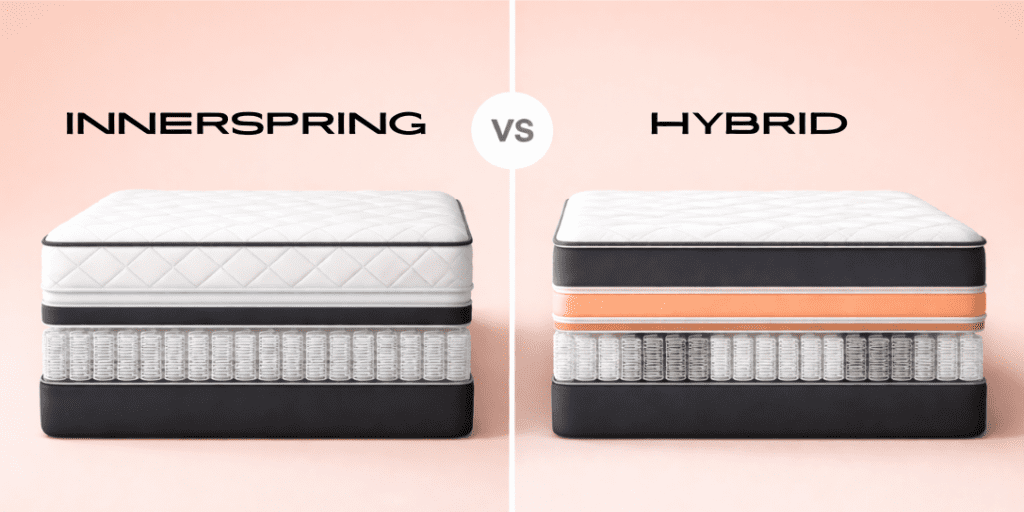
In essence, a hybrid mattress is a combination of a thick foam comfort layer on top of a pocketed coil system, while an innerspring mattress is a coil core with minimal padding on top. This key construction difference influences everything from the feel of the mattress to its durability.
Innerspring mattresses are built primarily around the coil system. The comfort layer on top is usually thin, sometimes just a quilted cover or a half-inch of foam which is why innerspring beds have such a firm and responsive feel. You sleep on the mattress rather than sinking into it.
Hybrid mattresses take a different approach. While they still have coils in the base, the comfort layer on top is significantly thicker, typically made up of two to four inches of memory foam, latex, or polyfoam.
This additional padding is what gives hybrid mattresses their characteristic adaptive feel – firm underneath, but soft on top.
Understanding the Hybrid Mattress
The hybrid mattress is a multi-layered bed that combines the traditional innerspring system with foam layers. The objective is to offer the pressure relief of foam layers with the responsive support of a coil system. This mattress type offers the best of both worlds, hence the name hybrid.
Pocketed Coils and Thick Comfort Layers
The difference between a hybrid and a standard innerspring mattress boils down to two elements: the type of coil and the thickness of the comfort layer.
Hybrids mostly use individually wrapped pocketed coils, where each coil is free to move within its own fabric pocket. This arrangement enables the mattress to conform more accurately to your body than the linked coils used in classic innerspring designs.
The comfort system that sits on top of the coils usually ranges from two to four inches. Depending on the brand, this layer can be made of memory foam, latex, or high-density polyfoam. Each material changes the feel of the mattress – memory foam gives a slow, body-hugging sink, latex offers a bouncier and more responsive feel, and polyfoam sits somewhere in between.
More luxurious hybrid models often include extra layers such as a transition foam area between the coils and the comfort layer. This helps to create a smoother feel and stops you from feeling the coils underneath. This multi-layer design is what makes hybrids more expensive and gives them a noticeably more sophisticated feel.
How Pocketed Coils Affect Motion Isolation
When you lay on a mattress with pocketed coils, the pressure you apply is only felt by the coils directly underneath you. The rest of the mattress remains unaffected. This is why hybrid mattresses are so good at isolating movement. In traditional innerspring mattresses, any movement can be felt across the entire mattress.
Who are Hybrid Mattresses Suitable for?
Hybrid mattresses are suitable for those who want to relieve pressure without sacrificing support.
If you sleep on your side, share a bed with a partner who moves around a lot, or experience discomfort in your shoulders and hips at night, a hybrid is designed for you. The combination of cushioned comfort and stable coil support makes it versatile enough for various sleeping positions, which is why hybrids have become the fastest-growing mattress category in recent years.
Hybrid mattresses are also a good choice for heavier sleepers because the coil system offers long-lasting support that foam-only mattresses can sometimes struggle to provide. The additional weight doesn’t wear down the comfort layer as quickly when it’s supported by a sturdy coil base.
Understanding Innerspring Mattresses
Innerspring mattresses are the classic mattress design, featuring a coil support system with a thin layer of comfort on top. These mattresses are designed to be firm, responsive, and reasonably priced. Even though innerspring mattresses are one of the oldest mattress technologies, they are still one of the most commonly sold mattress types in the United States today.
Types of Coils in Innerspring Mattresses
Innerspring mattresses, unlike hybrids that only use pocketed coils, can use a variety of coil types. The type of coil used depends on the manufacturer and the price of the mattress. The coil type can also affect the feel and performance of the mattress.
Here’s a breakdown of the different types of coils you’ll find in innerspring mattresses:
- Bonnell coils — The oldest type of coil, these are shaped like an hourglass and are all connected to each other. They’re durable and affordable, but they do tend to transfer motion across the mattress.
- Offset coils — These are similar to Bonnell coils, but they have a hinged design that allows them to conform a bit better to your body. You’ll usually find these in mid-range innerspring mattresses.
- Continuous coils — These are made from a single long wire that’s formed into rows of coils. They’re very durable and supportive, but they also tend to transfer motion.
- Pocketed coils in innerspring designs — Some modern innerspring mattresses use individually wrapped coils, but they have a much thinner comfort layer than a true hybrid mattress. This keeps them in the innerspring category in terms of both feel and price.
Coil gauge, which refers to the thickness of the wire, also affects how firm the mattress feels.
A lower gauge number means a thicker wire and a firmer feel. A higher gauge number means thinner, more flexible coils with a bit more give. Most innerspring mattresses use a gauge somewhere between 12 and 15, with 12 being the firmest end of that range.
Why Innerspring Mattresses Feel Firm and Responsive
Because the coils in most innerspring mattresses are connected and the comfort layer is thin, these mattresses push back against your body weight rather than absorbing it.
That on-top-of-the-mattress feel is what some sleepers prefer, particularly back and stomach sleepers who benefit from a firm, flat surface for spinal alignment. There’s less sinking, less body contouring, and noticeably more bounce.
Hybrid vs Innerspring Mattress: Side-by-Side Comparison
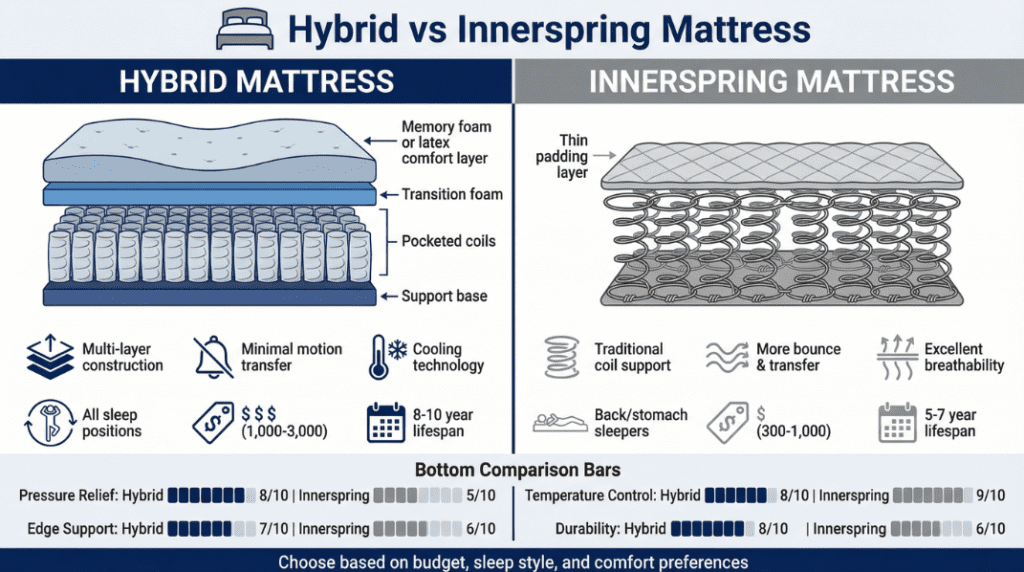
| Feature | Hybrid Mattress | Innerspring Mattress |
|---|---|---|
| Coil Type | Separately encased pocketed coils | Bonnell, offset, or continuous coils |
| Comfort Layer | 2–4 inches of foam or latex | Thin quilted cover or minimal padding |
| Pressure Relief | High | Low to moderate |
| Motion Isolation | Good | Poor |
| Cooling | Good (coil airflow, some foam heat retention) | Excellent (maximum airflow) |
| Durability | 7–10 years | 5–7 years |
| Average Cost | $800–$2,000+ | $300–$900 |
Hybrid vs Innerspring Mattress Performance: How They Actually Compare
After understanding the structural differences, it’s time to explore how these two types of mattresses perform in real-world conditions. Each category from pressure relief to price tells a unique story about which type of mattress is best suited for which type of sleeper.
There’s no clear winner between the two types of mattresses.
Innerspring mattresses excel in cooling and are more affordable. On the other hand, hybrid mattresses offer better pressure relief, motion isolation, and durability. The best choice for you will depend on your sleeping habits, body type, and budget.
1. Pressure Relief
Hybrids are generally the stronger performers here. The thick foam layer on top of a hybrid mattress provides relief to pressure points in areas like the shoulders, hips, and lower back by molding to the shape of the body. This pressure relief can help side sleepers and anyone who wakes up with joint pain from their mattress feel more comfortable.
When it comes to innerspring mattresses, they don’t offer much in terms of pressure relief. The thin padding on top doesn’t really contour to your body, so pressure builds up at contact points instead of being distributed. If you’re a side sleeper and you lay down on an innerspring mattress, you’ll probably start to feel that pressure at your hip and shoulder within minutes.
2. Spinal Support and Alignment
Both types can support proper spinal alignment, but they go about it differently. Hybrid mattresses use a combination of foam contouring and coil support to keep the spine in a neutral position. Innerspring mattresses support alignment through firmness, preventing the hips from sinking too far, which is important for people who sleep on their backs or stomachs.
The most important factor to consider is the position you sleep in. A firm innerspring mattress might keep the spine of a back sleeper in perfect alignment but leave the hips of a side sleeper out of position. A hybrid mattress adjusts more dynamically, which gives it an edge for combination sleepers who change positions during the night.
Here’s how the two types stack up for different types of sleepers:
- Side sleepers: Hybrids are better for side sleepers because the foam contours to your body at the hips and shoulders, which helps keep your spine aligned.
- Back sleepers: Either type can work for back sleepers, but firm innerspring mattresses do a better job of supporting the lumbar area without letting it sink too much.
- Stomach sleepers: Innerspring mattresses are generally better for stomach sleepers because they keep the hips from sinking too far into the mattress, which can cause the lower back to arch inward.
- Combination sleepers: Hybrids are better for combination sleepers because they adapt more easily to changes in position, making them a more versatile option.
If you share a bed with someone who sleeps in a different position than you, a hybrid is usually the safer choice because it can accommodate a wider range of needs without compromising on support for either sleeper.
3. Motion Transfer for Couples
- Hybrid mattresses have pocketed coils that are individually wrapped and compress independently. This means that any movement is isolated to one area and doesn’t spread across the surface.
- Innerspring mattresses have interconnected coils that allow motion to transfer freely. This means that if a partner moves or gets out of bed, it can be felt across the entire mattress.
This difference is particularly important for couples. If one person is a restless sleeper, their partner will be disturbed much more on an innerspring mattress than on a hybrid. The foam comfort layer in a hybrid also absorbs surface-level vibration, providing an additional barrier against motion transfer that innerspring mattresses don’t offer.
However, if you sleep by yourself, motion isolation is not a concern. Single sleepers don’t need to spend extra money on it, making the innerspring mattress a more economical option in this case.
One of the most overlooked aspects by novice mattress shoppers is the difference in motion isolation between these two types of mattresses. Many couples switch from an innerspring to a hybrid not for comfort reasons, but because they’ve had enough of being jolted awake every time their partner shifts.
4. Cooling and Temperature Regulation
Innerspring mattresses have a natural cooling advantage. Their open coil structure and minimal foam padding allow for maximum airflow, which helps prevent heat from building up during the night.
Hybrid mattresses also benefit from the airflow their coil systems provide, but the comfort layers above those coils can retain some heat, particularly when made from traditional dense memory foam. The thicker the foam layer and the denser the foam, the more likely it is to hold warmth near the body.
For hot sleepers drawn to hybrids, it’s worth looking for models that use gel-infused memory foam, open-cell foam, or natural latex in the comfort layer. These materials usually retain less heat than standard memory foam and can help keep the sleep surface at a more neutral temperature. That said, innerspring mattresses with minimal padding still tend to sleep cooler overall.
Both types sleep cooler than all-foam mattresses because the coil systems allow air to circulate freely through the base of the mattress.
5. Durability and Lifespan
Hybrid mattresses usually have a lifespan of seven to ten years. Their thicker comfort layers distribute body weight more evenly across the surface, which can reduce the concentrated wear that innerspring mattresses experience at high-pressure zones like the hips and shoulders.
Innerspring mattresses typically last around five to seven years before the comfort layer begins to compress and support becomes less consistent. Even when the coils are still in reasonable condition, the thin padding on top may break down first, making the surface uncomfortable regardless of what’s happening below it.
It’s worth noting that material quality matters significantly in both categories. Foam density, coil gauge, and overall construction have more influence on how long a mattress lasts than whether it’s labeled a hybrid or an innerspring.
6. Cost and Value
Innerspring mattresses are typically the least expensive option, with good quality ones ranging from $300 to $900. Hybrid mattresses, on the other hand, start at around $800 and can go well over $2,000 for high-end models.
But value isn’t just about the initial cost.
When you take into account lifespan and how long it stays comfortable, hybrids often offer more value per year of use, even though they cost more at first.
Which Mattress Type is Best for Your Sleeping Position?
How you sleep is one of the most important factors when deciding between a hybrid and an innerspring. Each position places different demands on the mattress, and getting this wrong is one of the main reasons people end up with a bed that causes discomfort rather than relieving it.
Pressure Relief for Side Sleepers
If you sleep on your side, you’re putting a lot of pressure on a small area, mainly your hips and shoulders. If you don’t have enough cushioning, you can cut off circulation or wake up with joint pain.
Hybrid mattresses are designed for this. The foam layer on top cushions your shoulder and hip, while the pocketed coils underneath keep your spine from sinking too far down. If you sleep on your side, an innerspring mattress may feel too hard for you.
Firm Coil Support is Beneficial for Back and Stomach Sleepers
Back sleepers require a mattress that supports the natural curve of the lumbar spine while preventing the hips from sinking too deeply.
Both hybrid and innerspring mattresses can provide this, but firm innerspring models are especially effective. This is because the minimal padding maintains a flat and resistant sleep surface. The coil system evenly pushes back across the body, preventing the type of hip sag that can misalign the spine and lead to lower back pain over time.
Stomach sleepers may benefit the most from a firm innerspring mattress. When sleeping face-down, it’s important for the hips to remain elevated and aligned with the rest of the body. If the hips sink into the mattress, it can cause the lower back to arch inward, leading to significant strain by morning.
A firm innerspring mattress, with its thin comfort layer and responsive coil core, can help keep everything aligned, which is crucial for stomach sleepers. Heavier stomach sleepers who find that even firm innerspring models eventually compress may want to consider a firm hybrid as an alternative. The coil system in a hybrid offers more structured, long-lasting resistance.
Who Should Consider a Hybrid Mattress
Hybrid mattresses are ideal for:
- Side sleepers
- Combination sleepers
- Couples who share a bed
- Those who experience pressure-related discomfort in the shoulders, hips, or lower back
The layered construction offers something that an innerspring mattress cannot – better cushioning that conforms to body shape while still providing the responsive, breathable support of a coil system underneath.
If you have ever woken up with a sore hip or a numb shoulder and blamed it on sleeping in the wrong position, the more likely cause is a mattress that is not providing enough pressure relief.
Hybrid mattresses are also great for heavier sleepers. The dense foam comfort layers provide surface cushioning without sinking too far down, because the pocketed coil system underneath provides sturdy, load-bearing support.
Couples in particular benefit from the motion isolation that individually wrapped coils and foam layers provide together. If one partner gets up in the middle of the night, the other partner stays asleep.
For anyone who wants versatility across sleeping positions, long-term durability, and a more sophisticated sleep feel, the hybrid mattress is the better investment.
Who Should Consider an Innerspring Mattress
Innerspring mattresses are ideal for:
- Stomach sleepers
- Those on a tight budget
- Solo sleepers
- Those that prefer a firm, traditional mattress
If you’ve always slept on a firm mattress and never felt the need for more cushioning, there’s no reason to pay extra for foam layers you won’t use.
Innerspring mattresses also win decisively for hot sleepers who want maximum airflow without worrying about foam heat retention.
Children’s beds, guest room mattresses, and anyone setting up a temporary sleeping space are also well-served by the lower price point and solid basic performance of a quality innerspring model.
Hybrid vs Innerspring – Which is the Better Mattress?
The best mattress for you isn’t necessarily a hybrid or an innerspring – it’s the one that suits your sleeping style, budget, and comfort needs.
While a hybrid mattress offers more features and versatility, it’s not necessarily the best choice for everyone. An innerspring mattress provides firm support, effective cooling, and affordable pricing, and for some sleepers, that’s all they need.
First, consider your preferred sleeping position. Then, think about whether you share your bed with someone else, whether you tend to sleep hot, and what your budget is. These four factors will usually make it clear which type of mattress is better for you.
If you’re still not sure, try lying down on both types of mattresses in a store. You’ll be able to tell the difference between a hybrid mattress and an innerspring mattress as soon as you lie down.
Frequently Asked Questions
Is it worth paying more for a hybrid mattress than an innerspring mattress?
For the majority of people, the answer is yes. Hybrid mattresses have a higher initial cost — usually between $800 and $2,000 compared to $300 to $900 for a good innerspring — but they last longer and offer significantly better pressure relief and motion isolation.
When you consider the cost per year of comfortable, supported sleep, the price difference between the two becomes much less significant. However, if you’re a stomach sleeper who prefers a firm surface and sleeps alone, an innerspring mattress will give you everything you need at a lower cost, so there’s no need to spend extra on a hybrid.
Are hybrid mattresses hot to sleep on?
That can vary depending on the materials used in the comfort layer. Hybrid mattresses that use traditional memory foam in their comfort layers can trap body heat because memory foam is a dense material that absorbs heat. However, the coil system in the base of the mattress does allow for significant airflow through the bottom part of the mattress, which is more than what an all-foam bed would allow.
Those who sleep hot should consider hybrid mattresses that use gel-infused memory foam, open-cell foam, or natural latex in the comfort layer. These materials are designed to reduce heat retention and keep the sleep surface at a neutral temperature. However, innerspring mattresses still have the edge when it comes to cooling, thanks to their minimal foam padding and maximum coil airflow.
What is the lifespan of an innerspring mattress compared to a hybrid mattress?
Generally, an innerspring mattress that is well-constructed will last from five to seven years before the comfort layer starts to compress and the support becomes inconsistent. Even if the coils are still in good condition, the thin padding on top may break down, making the sleeping surface uncomfortable regardless of the state of the coils.
Hybrid mattresses tend to have a lifespan of seven to ten years due to the fact that their thicker comfort layers spread body weight more evenly, which reduces wear and tear at pressure points. The combination of foam and pocketed coils in a hybrid mattress means that both systems support each other, extending the mattress’s overall lifespan compared to an innerspring mattress, where the thin comfort layer bears a disproportionate amount of surface-level stress.
Can a hybrid mattress help with back pain?
A hybrid may be a good option for some people with back discomfort because it can balance cushioning and support, but the best choice depends on body type, firmness preference, and sleep position.
Is it possible to replace a memory foam mattress with a hybrid mattress?
Yes, it is possible to replace a memory foam mattress with a hybrid mattress, and for many people, it’s a major improvement. The main benefits of a hybrid over a memory foam mattress are better cooling, more responsiveness, and easier movement on the mattress. The two most common complaints about memory foam mattresses are their slow response and heat retention. A hybrid mattress solves both problems by combining memory foam with a breathable coil system.
When you transition from an all-foam mattress to a hybrid one, it’s important to allow yourself a two-to-four week adjustment period. Your body has become accustomed to the sensation of foam-only support, and the added responsiveness of the coil system will initially feel noticeably different, even if the hybrid is objectively better suited to your sleeping needs.
Health Disclaimer: The information in this article is intended for general guidance only and does not constitute medical advice. If you experience chronic pain, a diagnosed sleep condition, or any medical issue that affects your sleep, please consult a qualified healthcare professional before making decisions based on this content. Individual results vary, and a mattress alone is not a treatment or cure for any medical condition.

Sleep Essentials Hub is a sleep blog for readers who want helpful sleep guides and honest product recommendations. We’re passionate about better rest, with a focus on pillows and bedding, sleep aids, sleep apnea and CPAP gear, natural sleep supplements, sleep tech, and simple ways to improve your sleep environment. We’re here to help you choose products that support deeper sleep, greater comfort, and a better night’s rest without overspending.