
Mulberry Silk Pillowcase Benefits: How It Helps With Hair, Skin & Sleep
If you’re tired of waking up with bird’s nest hair, pillow creases, or skin that feels parched before you even get to your morning coffee, your pillowcase might be working against you.
Mulberry silk pillowcases have become one of the most talked about upgrades in hair care, skincare, and sleep wellness circles. But are the benefits real, or just another overhyped beauty trend?
Here’s what actually happens when you swap cotton for mulberry silk, based on textile research and what users report.

Disclosure: This article is reader-supported and contains affiliate links. We may earn a small commission on qualifying purchases at no extra cost to you. Thank you for your support.
Do Silk Pillowcases Really Work? What We Know So Far
The short answer: yes, with some caveats.
While direct clinical research on silk pillowcases is still limited, the documented properties of silk’s fibers explains why people report waking up with less frizz, fewer tangles, and hair that looks less roughed up than it does after sleeping on cotton.
One of the biggest differences is friction. In textile testing, silk typically measures lower surface friction than cotton’s rougher weave, although results vary with weave and moisture.
That smooth, low-friction feel is one of the main reasons silk pillowcases are often linked to reduced frizz, fewer knots, and less stress on delicate strands.
What Makes Mulberry Silk Different from Other Types of Silk
Not all silk is the same, and that difference can have a real effect on the results.
Mulberry silk comes from Bombyx mori silkworms raised on an exclusive diet of mulberry leaves. This controlled feeding environment produces silk fibers that are longer, more uniform, and exceptionally smooth compared to wild silk varieties like tussah or eri silk.
What makes this relevant to your skin? Mulberry silk is a natural protein fiber, and its smooth, uniform structure is what gives it that signature soft, cool-to-the-touch feel. That smoothness isn’t just a surface texture. It’s built into the fiber itself, which is why mulberry silk feels noticeably gentler than wild silk varieties or synthetic alternatives, especially on reactive or easily irritated skin.
Regular silk or silk blends lack this fiber consistency. And synthetic satin (typically made from polyester) might feel similar to silk at first, but it can feel hot and sweaty against the skin.
In short, satin can give hair a similar smooth surface, but silk’s natural fiber is what makes it feel cooler and less plasticky against your face.
Silk Pillowcase Benefits for Hair: Less Frizz and Fewer Tangles
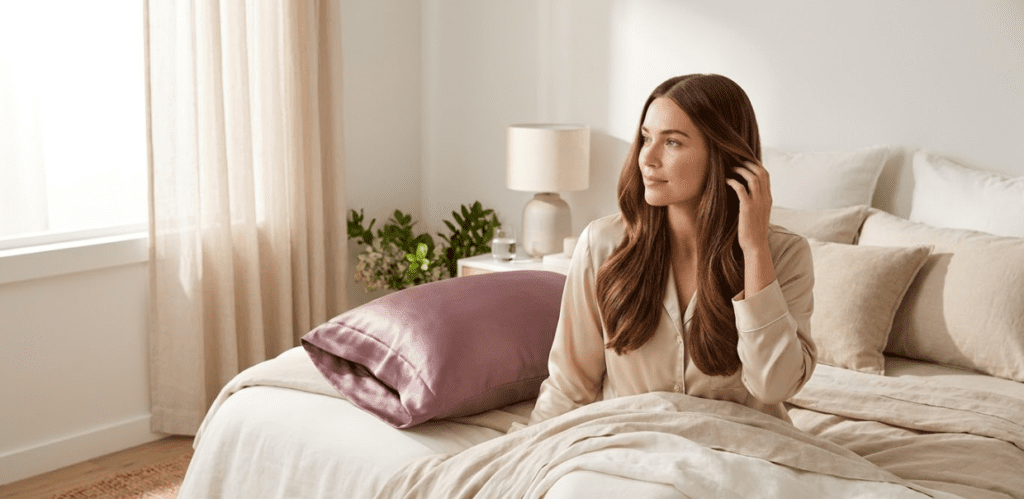
Hair protection is usually the number one reason people try a silk pillowcase, and where some people start noticing results first.
Smoother, More Defined Curls by Morning
If you have curly, coily, or wavy hair, you already know the frustration. You spend time defining your curls at night, only to wake up with flat curls on one side, frizz everywhere else, and what can only be described as triangle hair.
Silk’s ultra-low friction surface lets your curls move freely without catching, pulling, or flattening. Many people with natural curls report that their curls stay noticeably more defined overnight, with less frizz and tangling by morning. Some find they need less styling product and fewer touch-ups to get out the door.
If your bonnet keeps slipping off during the night and leaving your hair unprotected on cotton, a silk pillowcase provides consistent protection from the moment you lay down.
Not sure which option is right for you? Here’s our breakdown of silk sleeping caps vs. silk pillowcases.
Less Snagging on Fine and Fragile Hair
Fine, fragile, and damaged hair benefits from silk’s smooth surface in a different way. Cotton’s rougher fiber structure creates friction every time you change positions during sleep, and over time, that friction may contribute to split ends and breakage.
Silk lets your hair glide instead of catching. While a silk pillowcase can’t repair damage that already exists, it reduces nightly friction, which may mean fewer tangles and less breakage over time.
For anyone dealing with persistent hair damage or thinning, reducing friction during 7 to 8 hours of sleep each night adds up. If breakage is your primary concern, check out our guide to the best silk pillowcases for hair breakage.
Blowouts and Styled Hair That Actually Last
If you invest time or money in professional blowouts, rollersets, or heat styling, silk pillowcases help that work survive the night. The smooth mulberry silk surface doesn’t catch or disrupt styled hair the way cotton does.
Many people find their blowout lasts an extra day or so instead of starting over each morning. For anyone with shoulder-length or longer hair, the difference is especially noticeable since there’s more hair in contact with the pillowcase overnight.
Silk Pillowcase Benefits for Skin: Fewer Creases and a Gentler Surface
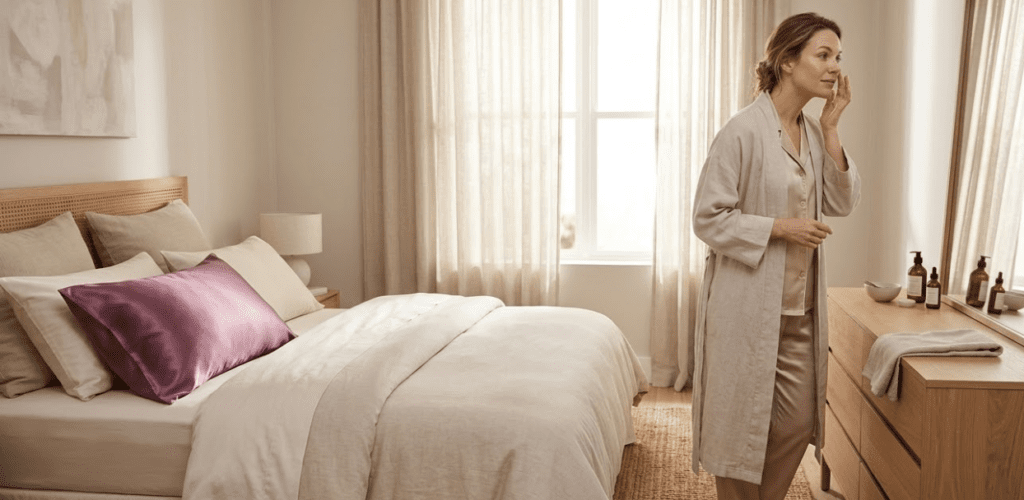
Skin benefits are a close second to hair, and this is where the beauty-meets-science angle gets really interesting.
Less Night Cream on Your Pillowcase
Cotton is absorbent by design. That’s great for towels. It’s not great for a surface your face rests on for hours while wearing retinol, hyaluronic acid, or a $60 night cream.
Cotton soaks up some of your serum and night cream overnight. Silk absorbs less face cream, so less product ends up in the pillowcase.
If you’ve ever flipped your cotton pillow over and noticed product stains or a greasy residue, you’ve seen the problem firsthand.
Fewer Sleep Creases and Pillow Lines
Side and stomach sleepers know the drill. You wake up, look in the mirror, and there they are: deep creases pressed into your cheek and forehead from hours of contact with your pillowcase.
These are temporary creases, not wrinkles, and no pillowcase has been shown to prevent wrinkles. Fewer pillow marks in the morning is the realistic benefit.
If minimizing wrinkles is your main priority, our guide to the best pillowcases for face wrinkles compares the top options by fabric and weave.
A Gentler Choice for Acne-Prone and Sensitive Skin
Many people prefer silk for sensitive or breakout-prone skin because the smoother surface creates less friction and irritation than rougher fabrics. Less rubbing against your face overnight may mean less aggravation for skin that’s already reactive.
That said, silk doesn’t work for everyone. A small number of people with very reactive skin have reported that silk actually worsened their breakouts or triggered irritation. Silk pillowcases are not a treatment for acne or eczema, and individual responses vary. If you have a history of textile sensitivities, start with one pillowcase and monitor your skin for a few weeks before committing.
For those specifically managing breakouts, washing your silk pillowcase frequently (once a week, or more often if you have oily skin) and using a gentle, fragrance-free detergent gives you the best chance of positive results.
We also put together a full guide to the best pillowcases for acne-prone skin if you want to compare fabric options side by side.
Silk Pillowcase for Hot Sleepers: Does It Actually Feel Cooler?
If you’re someone who flips your pillow throughout the night searching for the cool side, you may find that silk feels noticeably cooler and less clammy than both cotton and synthetic satin.
Unlike polyester satin, which can trap heat against your skin, real silk breathes more naturally. Some describe it as a surface that feels cool to the touch and doesn’t build up that sticky, warm feeling overnight.
For hot sleepers, this can mean a more comfortable night without the constant pillow-flipping.
For women navigating perimenopause or menopause with night sweats and hot flashes, a silk pillowcase may feel more comfortable than cotton or polyester.
It’s worth being honest here: silk alone won’t eliminate night sweats. But some women find that silk combined with other cooling strategies (breathable sheets, a fan, lighter bedding) creates a noticeable improvement in how they feel overnight.
Is Silk Good for Sensitive Skin and Allergies?
Silk’s smooth surface may feel more comfortable on sensitive skin because it creates less friction than rougher fabrics. Some people with eczema or rosacea prefer that softer contact, but silk doesn’t treat either condition.
OEKO-TEX Standard 100 certification means the finished fabric has been tested for harmful substances. It doesn’t make a pillowcase allergy-proof, and regular washing still matters because dust, skin oils, and product residue build up over time.
One important note: while genuine silk allergies are rare, a small number of people have reported skin reactions (hives, irritation) that they attribute to silk. If you or your child has a history of textile allergies, test cautiously.
Bamboo or high-quality cotton sateen may be a better fit for truly reactive skin. For those who prefer a cruelty-free option entirely, here’s our look at vegan alternatives to silk pillowcases.
Silk vs. Satin vs. Cotton: Understanding the Real Differences
- Silk vs. satin is not an apples-to-apples comparison. Satin is a weave pattern, not a fiber. Satin pillowcases can be made from silk (silk satin), but they’re most commonly made from polyester. Polyester satin feels smooth and gives hair a similar low-friction surface, but many people find it hot and sweaty.
If satin feels hot, staticky or plasticky, a real mulberry silk pillowcase is the upgrade. - Silk vs. cotton is more straightforward. Cotton’s rougher fiber structure creates more friction, soaks up more of your skincare products, and generally feels less smooth against skin and hair. That said, cotton is easier to wash, cheaper to replace, and widely available. For hair protection, overnight comfort, and a smoother feel against your face, most people find mulberry silk a clear step up.
- The bottom line: For a low-friction, breathable, smooth sleep surface, 100% mulberry silk has clear advantages over both cotton and synthetic satin. Whether it is worth the higher price really comes down to which benefits matter most to you.
How to Choose a Quality Mulberry Silk Pillowcase
With so many options on the market (and a fair share of misleading listings), here’s what to look for to make sure you’re getting the real thing.
- Momme weight is the silk equivalent of thread count, and it’s the most reliable quality indicator. Look for a momme weight between 19 and 25 for the right balance of softness and durability. 22 momme is widely considered the sweet spot: dense enough to last years without feeling heavy or stiff.
- Fiber content should say 100% mulberry silk. Products labeled simply as “silk” or “silky” may be blended with other fibers or made entirely from polyester. Reputable brands will clearly state mulberry silk on the packaging and provide sourcing details.
- Silk grade is another quality marker to look for. Grade 6A is widely marketed as the top quality tier, indicating longer, more uniform fibers with fewer impurities. While grading isn’t universally standardized, reputable brands that specify their grade are generally more transparent about what you’re getting.
- Closure type is a practical detail worth considering. Zipper closures work better for restless sleepers because they keep the pillow from sliding out of the case. Envelope closures look clean but may not stay put if you move a lot at night. Silk is naturally slippery, so a secure closure can avoid the common frustration of the pillowcase being halfway off in the middle of the night.
- How to spot fake silk: Real silk feels cool to the touch, has a subtle sheen (not overly shiny like polyester), and when burn-tested, produces ash rather than melting. If a listing is vague about momme weight, fiber content, or origin, proceed with caution.
If you want a side-by-side look at the brands that actually meet these quality standards, our review of the best silk pillowcase brands breaks down the top options by momme weight, construction, and user feedback.
A 100% Mulberry Silk Pillowcase Worth Considering

If you’re looking for a well-made mulberry silk pillowcase that checks all the quality boxes, Blissy is one of the most popular options on the market.
You can read our full Blissy silk pillowcase review here for a detailed breakdown.
It uses 22-momme, Grade 6A mulberry silk (widely recognized as a top quality tier) with clearly listed fiber content and momme weight, so you’re not guessing about what you’re actually sleeping on.
That 22 momme weight is worth mentioning because it is dense enough to handle regular washing without thinning out, while still feeling light and cool against your skin.
The hidden zipper closure is a small detail that solves one of the most common silk pillowcase frustrations. Silk is naturally slippery, so a zipper that keeps the pillow in place makes a real difference night to night.
Blissy runs regular sales, so check today’s price on the official site
How to Care for Your Silk Pillowcase (So It Lasts for Years)
Proper care for a silk pillowcase is simpler than most people expect, and it can make the difference between a pillowcase that lasts a few months and one that holds up for several years.
- Washing: Use cold water with a gentle detergent (formulas designed for wool or silk work best). Delicate cycle or hand washing both work well for quality silk. Wash your silk pillowcase at least once a week, or more frequently if you have oily skin or hair.
- Drying: Air dry away from direct sunlight. Lay flat or hang to prevent stretching. If you use a dryer, choose the lowest heat for a short time. Blissy allows up to 20 minutes on low.
- What to avoid: Never use bleach or fabric softener on silk. Both break down the fibers and strip the natural properties that make silk beneficial in the first place.
- When to replace: A high-quality silk pillowcase can last for years with proper care. Replace when the surface feels noticeably rough, or you see pilling that doesn’t smooth out after gentle washing.
Higher momme silk (22 and above) handles regular washing much better than lower-weight options. If easy care matters to you, this is one more reason to invest in a durable weight upfront.
Common Concerns About Silk Pillowcases
“They’re too expensive.” Quality mulberry silk pillowcases range from about $30 to $120. It’s a bigger upfront cost than cotton, but when you factor in years of nightly use, many people find the cost-per-use worthwhile. Starting with one pillowcase to test the benefits is a practical first step.
“I’m worried about buying fake silk online.” This is a valid concern. Look for listings that specify momme weight, silk grade, and fiber content. Avoid vague descriptions like “silky smooth” without technical details. Checking reviews that mention the feel, durability, and specific quality markers can also help verify authenticity before purchasing.
“Will silk help my acne?” Some people with acne-prone skin find silk’s smoother surface feels calmer, but silk isn’t an acne treatment. Washing your silk pillowcase frequently and using a gentle, fragrance-free detergent gives you the best chance of positive results. If your skin reacts negatively after a few weeks, bamboo or high-quality cotton may be a better match.
“Isn’t satin just as good?” For reducing surface friction, synthetic satin can offer a similar smooth feel, especially for hair. But satin made from polyester doesn’t breathe as well, and can feel hotter than real silk. If frizz reduction is your main goal, satin may work well enough. If you also want a surface that feels cooler and breathes better, mulberry silk offers advantages that polyester satin doesn’t.
Is a Mulberry Silk Pillowcase Worth It?
A silk pillowcase won’t replace your skincare routine or undo years of heat damage overnight. But for a single swap that requires zero extra effort, the cumulative benefits are hard to ignore.
Less frizz. Fewer tangles. Less of your night cream on the pillowcase. A cooler, more comfortable sleep surface. And all of it happening passively, every single night, for years.
Many people who try a quality mulberry silk pillowcase say the same thing: they wish they’d made the switch sooner. For the cost of a few salon blowouts or a mid-range serum, it’s one of the simplest upgrades you can make for your hair, skin, and sleep.
Frequently Asked Questions
What is a mulberry silk pillowcase?
A mulberry silk pillowcase is made from silk produced by Bombyx mori silkworms that feed exclusively on mulberry leaves. This controlled diet produces exceptionally smooth, uniform silk fibers that are used to create high-quality pillowcases with a smooth, low-friction surface for hair and skin.
Are silk pillowcases really worth it?
For many people, yes. The reduced friction alone improves hair smoothness and overnight comfort. Silk also absorbs less night cream than cotton. Results vary, but less frizz and fewer tangles are the most common changes people notice.
How often should you wash a silk pillowcase?
It’s recommended to wash your silk pillowcase once a week, or more frequently if you have oily skin, oily hair, or use heavy styling products.
Do silk pillowcases really help with wrinkles?
Silk pillowcases can mean fewer temporary pillow creases for side sleepers, but they haven’t been shown to prevent or reduce wrinkles. Daily sunscreen and a retinoid do far more for skin aging.
How long do silk pillowcases last?
With proper care (cold wash, air dry, gentle detergent), a quality mulberry silk pillowcase at 22 momme or higher can last for years. Lower momme weights may wear out faster with regular washing.
Are there any alternatives to silk pillowcases?
Satin pillowcases can offer similar benefits to silk at a lower cost, though they may not be as durable or luxurious feeling, and less suitable for hot sleepers.
Can silk pillowcases help with frizzy hair?
Many users with curly or frizz-prone hair report reduced frizz and better hair manageability when using silk pillowcases.
Are silk pillowcases good for all skin types?
Silk is generally well tolerated by many skin types because of its smooth, low-friction surface. Many people with sensitive skin, eczema, or rosacea find it more comfortable than rougher fabrics. However, not every person responds the same way, and a small number of people may experience sensitivity to silk itself.
How do you know if a silk pillowcase is real?
Look for pillowcases labeled as 100% mulberry silk with a momme weight listed. Reputable brands will provide this information.
Disclaimer: Silk pillowcases are not intended to diagnose, treat or prevent any skin, hair or sleep condition, and individual results vary.

Sleep Essentials Hub is a sleep blog for readers who want helpful sleep guides and honest product recommendations. We’re passionate about better rest, with a focus on pillows and bedding, sleep aids, sleep apnea and CPAP gear, natural sleep supplements, sleep tech, and simple ways to improve your sleep environment. We’re here to help you choose products that support deeper sleep, greater comfort, and a better night’s rest without overspending.